White Elephant Gift Exchange Rules, Plus 3 Other Ways to Play
By Iaroslav Pavlov · Updated September 27, 2026
White Elephant is a gift swap where people can steal what someone else unwrapped. Everyone brings one wrapped gift, nobody knows who brought what, and the best gifts change hands several times before the game ends. It works for families, groups of friends and office parties, and it needs very little preparation.
Other names for it are Yankee Swap and Dirty Santa. The rules are the same or close to it.
The classic White Elephant rules in 7 steps
- Bring a gift. Each player brings one wrapped gift within the agreed budget and puts it on the gift table. Wrap it well, so the shape gives nothing away.
- Draw a number. Each player draws a number. That is the turn order.
- Player 1 opens a gift. They pick any wrapped gift and open it so everyone can see.
- Open or steal. On each turn after that, the player either opens a new gift from the table or steals a gift someone has already opened.
- No instant steal-backs. A player whose gift was stolen opens a new gift or steals a different one. They can't take back the gift that was just taken from them.
- Three steals and it's locked. A gift can be stolen three times. After the third steal it stays with whoever has it.
- The final swap. When every gift is open, Player 1, who never had a choice, may make one last steal. Then everyone keeps what they hold.
Write these on a sign or print a rules page and put it by the gift table. Most arguments at a White Elephant party start with "I thought we said..."
How many steals should you allow?
Three steals per gift is the most common limit, and it's the one we use. With no limit, one popular gift can bounce around the room for twenty minutes. With one steal, the game ends before it gets interesting.
Keeping count is the hard part once a gift has changed hands a few times. Two simple fixes: tie a tag to each gift and mark a star on it at every steal, or have the host keep a list of who holds what.
Setting the budget
Put the budget on the invitation, with the date, so nobody arrives with a $5 candle when everyone else spent $25. Common limits are $15, $20 and $25. For an office party, keep it on the low side so nobody feels pushed.
A theme can help people shop: something cozy, something useful, a book, something from your hometown. Keep it loose, or half the guests will ask what counts.
Playing with a big group
The classic version works well for up to about 20 people. With 30 or 40 it can take over an hour, and the people who went first sit waiting. A few ways to keep it moving:
- Set a time limit per turn, 30 seconds to decide.
- Lower the steal limit to two.
- Split the room into two circles, each with its own gift table.
- Play one of the faster versions below.
Three other ways to play
The dice game
Everyone sits in a circle with the gifts in the middle and one die. In the first round, players roll in turn, and each number means something: pick a wrapped gift, swap with anyone, pass the die left or right, roll again. The round ends when every gift has been picked.
In the second round, set a timer for 5 to 10 minutes and keep rolling. Now the numbers mean open your gift, steal any gift in the room, swap with a neighbor or lose your turn. When the timer rings, the gift in your hands is yours. It takes 15 to 25 minutes and suits 5 to 20 players.
The LEFT-RIGHT story
Everyone sits in a circle holding a wrapped gift. One person reads a short story out loud, slowly. Each time they say "left," everyone passes their gift to the left, and each time they say "right," to the right. When the story ends, you keep what you hold. It takes about 5 minutes, works for up to 30 people and is a good pick for kids, since nobody gets anything stolen from them.
You can write your own story or use a ready one. It only needs the words "left" and "right" to come up often, sometimes as part of other phrases ("right on time," "nothing left").
Twist cards
Play the classic version, but at each turn the player also draws a card with a twist: trade with the person who traveled farthest, pass your gift two places to the left, stay safe this round. It adds a bit of chaos to a group that has played White Elephant many times. If a card fits nobody in the room, the player keeps their gift.
Common questions from hosts
Do guests who didn't bring a gift get to play? Usually no, or the numbers stop adding up. Keep a spare gift or two if you expect late or empty-handed guests.
Can a gift be stolen on the final swap if it's locked? No. A locked gift stays locked, even for Player 1's last move.
Should kids and adults play together? It works if the budget and the gifts suit both. Many families run a separate kids' round with the LEFT-RIGHT story, so no one ends up in tears.
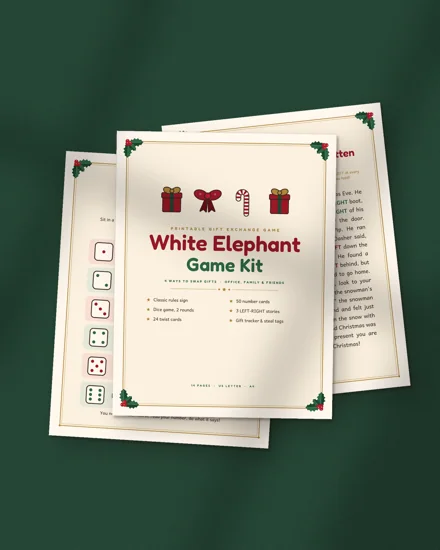
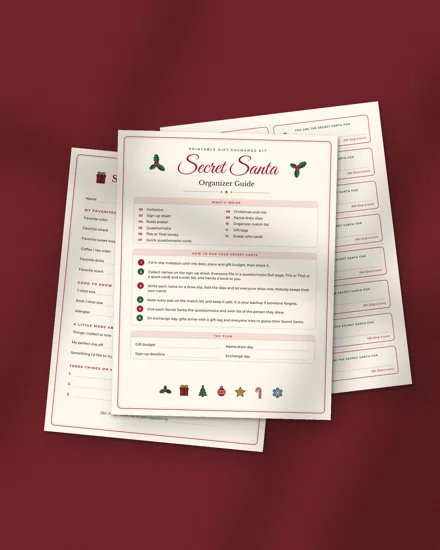
If you want everything printed and ready, our White Elephant game kit has the rules sign, 50 number cards, the dice game, three LEFT-RIGHT stories, 24 twist cards and steal-counter tags. For a gift swap where each person buys for one name they drew, see the Secret Santa kit instead.
Questions and answers
What is the difference between White Elephant and Secret Santa?
In Secret Santa, each person draws a name and buys a gift for that one person. In White Elephant, everyone brings a gift for the pile, and turns and steals decide who takes home which one.
How long does a White Elephant game take?
The classic version takes about 30 to 60 minutes for 8 to 40 players. The dice game takes 15 to 25 minutes, and a LEFT-RIGHT story about 5.
What is a good White Elephant gift?
Something most adults would be glad to steal: a nice mug with cocoa, a board game, a cozy blanket, a gadget within the budget. Funny gifts work too, as long as the group enjoys that kind of joke.