
In this guide
- What a visual schedule is
- Pick one routine that's hard right now
- Choose how many cards
- Make the cards clear
- Put it where the routine happens
- How to use a visual schedule during the routine
- Use the same order every day
- Fade it out slowly
- Visual schedule examples for different ages
- First / Then boards
- Where chore charts fit in
To use a visual schedule, put picture cards for the steps of one routine in order on a board, show your child the next card before each step starts, and move the card to "All done" when the step is finished. Start with one routine and two or three pictures, use it every day in the same order, and add steps only when your child follows the short version without help.
The rest of this guide covers the details that decide whether it sticks: which routine to pick first, how many cards a two- or three-year-old can handle, where the board goes, and how to change the plan when the day doesn't go as expected.
What a visual schedule is
A visual schedule is a row of pictures showing what happens next, one picture per step. A child who can't read yet can look at it and see that after breakfast comes getting dressed, and after that it's shoes and out the door.
It can be as small as two cards ("First bath, then story") or as long as a whole day. The pictures do the reminding, so you say "check your board" instead of repeating the same instruction five times. Parents, preschool teachers and special education teachers all use them, often with autistic kids or kids with ADHD, but plenty of young children with no diagnosis do better with one too.
1Pick one routine that's hard right now
Start where the friction is. For most families that's one of these:
- Morning: wake up, toilet, get dressed, breakfast, brush teeth, shoes on.
- Bedtime: bath, pajamas, brush teeth, story, lights out.
- Leaving the house: toilet, shoes, coat, bag, car.
- After daycare or school: snack, play, dinner, bath.
Pick one. Three new boards at once is a lot to learn for a small child. Once the first routine runs without much help, add the next.
- Good forages 2 and up ·
- Time10 minutes to set up
2Choose how many cards
How many cards to use depends on the child's age and attention. A rough guide for home use:
- About 2 years old: a First / Then board with two cards. "First shoes, then park." That's enough to teach how the board works.
- About 3 years old: three to five cards for one routine.
- About 4 to 5 years old: a full routine of six to eight steps, or half a day.
- School age: a whole day, with times next to the cards if your child reads a clock.
If your child ignores the board or gets upset by it, cut the number of cards in half and try again for a week. Long boards look like a wall of work to a small child.
3Make the cards clear
Each card should show one action, with a short word under the picture. "Brush teeth," not "Get ready for bed." A real photo of your child's own toothbrush works just as well as a drawing, and some kids understand photos faster.
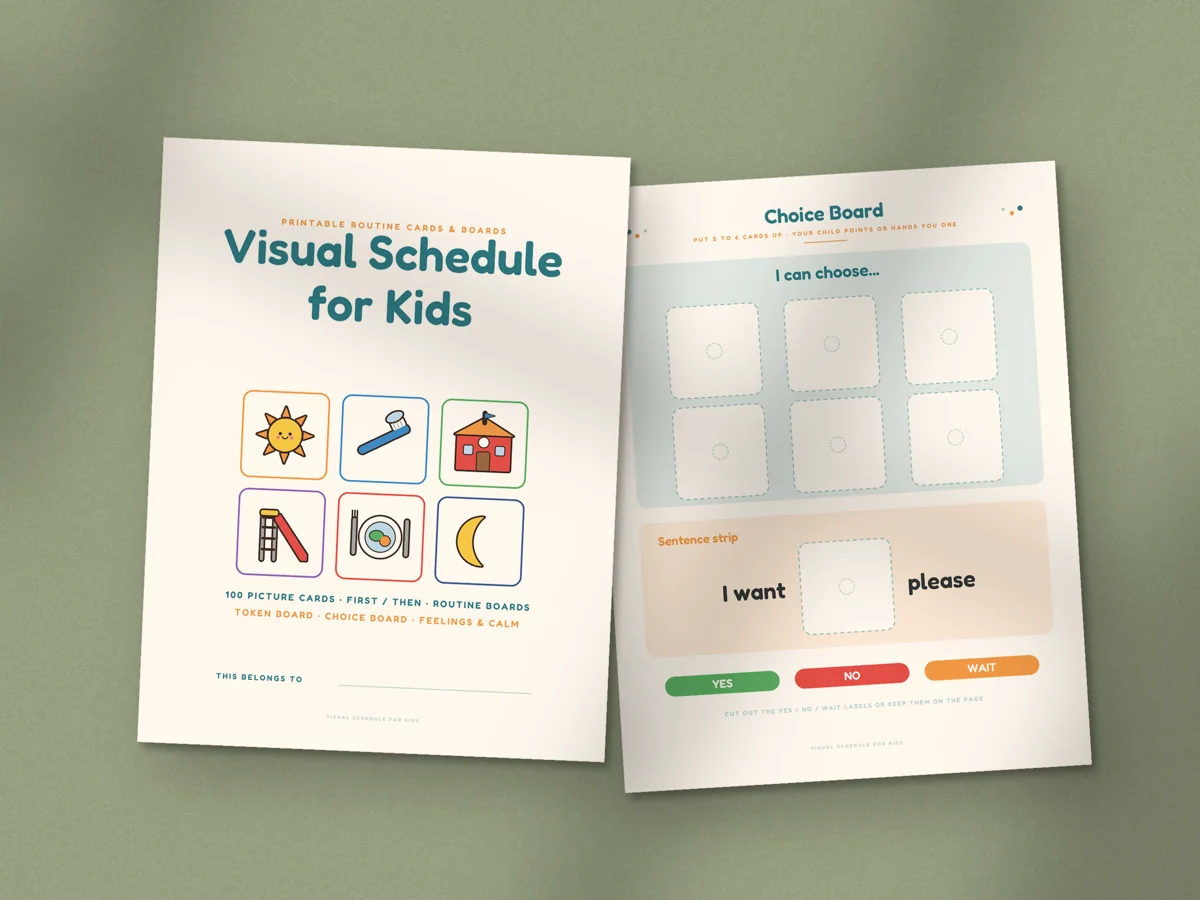
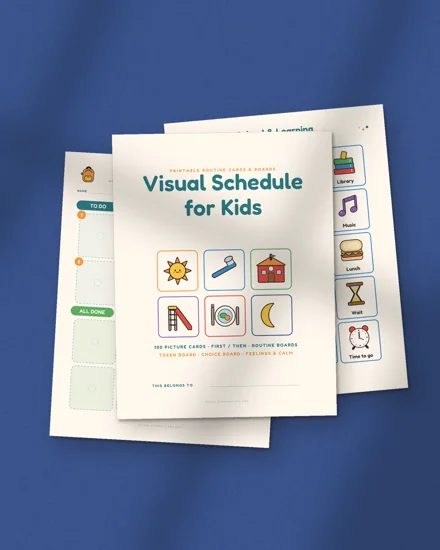
To make a visual schedule yourself, draw simple pictures on index cards or print photos, cover them with clear tape, and stick them on a strip of cardboard. If you'd rather print a finished set, our visual schedule printable has 100 picture cards in five sets (morning, school, play, home and chores, evening and feelings), 20 blank cards for your own drawings or photos, and boards for First / Then, morning, afternoon, bedtime and a whole day.
Card stock and a laminator, or sheet protectors, keep cards from bending after a week of small hands. For printer settings and paper weights, see how to print printables at home.
4Put it where the routine happens
Hang the board at your child's eye level, next to where the routine takes place. A morning board goes by the bedroom door or in the bathroom, a leaving-the-house board by the front door. A board in the kitchen for a routine that happens upstairs won't get looked at.
Hook-and-loop dots let cards move from the "To do" side to "All done": hook side on the board, soft side on the card. A pocket, an envelope or a basket for finished cards does the same job.
5How to use a visual schedule during the routine
Walk through the board together the first few days. Point to the next card, say the word, do the step, then let your child move the card to "All done." Many kids like moving the card best, so give that job to them.
Keep your words short. "Teeth next" while pointing at the card works better than a sentence. After a week or two, try only pointing and see if your child gets there alone.
- Good forthe first 1 to 2 weeks ·
- Timea few extra minutes per routine
6Use the same order every day
A schedule helps because it's predictable. Keep the steps in the same order each day, even when it would be quicker to skip one. If the board says bath before pajamas, do bath before pajamas.
When the day really is different (a doctor visit, a birthday party, a grandparent picking up), show it on the board before it happens. Swap in the new card in the morning and point to it: "Today, after lunch, Grandma." If there's no card for it, draw one on a blank card.
7Fade it out slowly
Most kids need the board less as the routine becomes habit. Signs your child is ready: they start the next step before you point, or they tell you what comes next.
Fade it in stages:
- Stop pointing and let your child check the board alone.
- Group two steps on one card, like "wash and dress."
- Keep only the first and last card, or move to a written checklist if your child reads.
- Take it down. Put it back up if a new baby, a move or a new school shakes the routine.
Some children like to keep their board for a long time, and that's fine.
Visual schedule examples for different ages
Change the steps to match your house.
- Two-year-old, going out: First shoes, then park.
- Three-year-old, bedtime: bath, pajamas, brush teeth, story, bed.
- Four-year-old, morning: toilet, get dressed, breakfast, brush teeth, shoes on, car.
- Five-year-old, after school: snack, play, homework or reading, dinner, bath, bed.
Potty training is a good place for a short step-by-step board too: toilet, flush, wash hands, dry hands. Our potty training chart set has an eight-step potty routine page and nine matching cards for that. For the sticker chart side of it, see how to use a potty training sticker chart.
First / Then boards
A First / Then board is the smallest visual schedule: two spaces, one card in each. The first card is the task, the second is what comes after it, often something the child wants. "First get dressed, then blocks."
It's a good way to introduce pictures to a toddler, and it stays useful for older kids during hard moments, such as leaving a playground or starting homework. Always follow through on the "then" card, or the board stops meaning anything.
Where chore charts fit in
A visual schedule shows the order of a routine. A chore chart tracks jobs over a week, like feeding the pet or tidying toys, often with stars or points. Many families use both: the schedule for getting through mornings and bedtimes, the chart for helping around the house. Our picture chore chart set includes morning, after-school and bedtime routine pages with eight picture steps each, which work as a simple visual schedule on the fridge.
Questions and answers
What age can you start a visual schedule?
Many parents start around age 2 with a First / Then board and two cards. A good sign is that your child can match a picture to a real object, like pointing at a picture of a cup when you show them a cup.
How many pictures should a toddler's visual schedule have?
Two to five. Start with two on a First / Then board and add one card at a time once your child follows the short version. If they stop paying attention, the board is probably too long.
Should a visual schedule have times on it?
Only if your child can read a clock, or for a school-day plan. For toddlers and preschoolers, the order matters more than the time, so leave times off.
What if my child refuses to use the visual schedule?
Make it shorter, put a favorite activity as the last card, and let your child move the cards. Give it a week or two of daily use before deciding it doesn't work.
When should you stop using a visual schedule?
When your child follows the routine without looking at the board. Fade it out in steps, and bring it back during big changes like a move, a new sibling or a new school.